In this ever-changing world, a good learner is a life-long learner. How can we expect our students to be efficient learners when we don’t cater for our own self-development as teachers?
To begin with, it is crucial to realize that expanding
our EFL knowledge and teaching skills is something that we do throughout our
lives. It is not something that we do once. This is the reason we need a tool
that can inform us without going through a hassle. In my opinion the social
media can function as an information tool.
As digital immigrants, we should to try to align
ourselves with this era, even though our upbringing is rather different. Since
we are living in this digital age, where the social media have conquered every
aspect of our life, it is a natural outcome that our professional development
may derive from such means. Hence, this blog’s entry will focus on how teachers can expand their ELT
knowledge through the social media and especially through Twitter.
Bear in mind that when you sign up for a Twitter
account you cannot change your name. So the is no messing around with it…
By default Twitter doesn’t lend itself to socialize.
In particular, the chat won’t pop up at at the bottom or on the side of your
Twitter page. To enter the chat you click on the icon and the whole pages
switches to your chat room. So, there is no chatting and browsing
simultaneously as in facebook.
Don’t panic, if you think that you have to visit all
the 20-30 pages of people or organizations that you have chosen to follow.
Thanks to the RSS news feed you can choose which sites you want to receive
updates automatically without visiting them. That way you can keep track of any
upcoming book, conference, seminar and workshop that is related to our field.
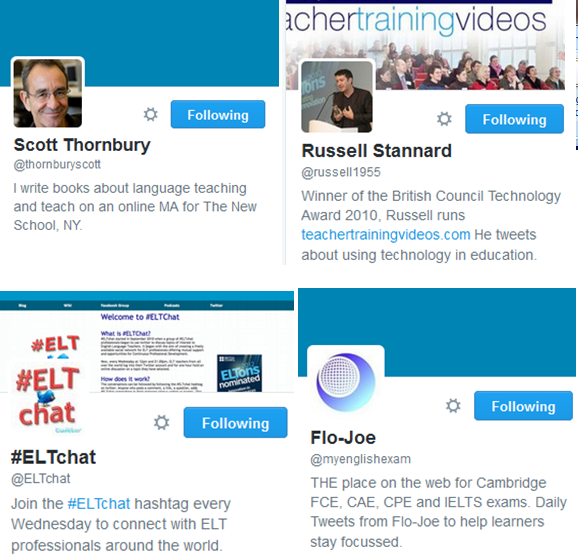
Here are some Twitter ELT eminent figures that I
suggest you follow:
Pros
- You expand your Personal Learning Network through online chats with other ELT professionals. This gives you the advantage to learn from other teachers so as to enhance you teaching skills or deal with challenges that arise in the EFL classroom as well as share resources (e.g. grammatical worksheets etc). Twitter facilitates this compared to other social media tools because it is predominantly used for professional purposes. This provides the opportunity to exchange experiences and support each other.
- You become acquainted new teaching approaches that enable you to refine you teaching skills.
- You receive updates regarding examinations, new course books, conferences, seminars etc.
Cons
- You get informed provided that you go online regularly. For those ELT teachers who are under the category of the “digital immigrants” they should radically change their stance and remain connected.
- Some claim that other sites like facebook are more efficient because more people log in on a daily basis for entertainment. Indeed, by including professional information in such sites at times gets the message across much easier compared to sites that function mainly for professional purposes.
Though many EFL teachers don’t realize it, the
social media can act as an invaluable tool for a teacher’s self-development. It
all depends on how open-minded you are to embrace such unconventional means of
self-development.
I believe that EFL teachers are quite cynical when
it comes to the social media and they lose from it.
Let’s all open-minded EFL teachers pull together and
sensitise them to change.


